In the 21st-century, elite sport is more than just competition; it’s centre stage for talent, influence and international power plays.
From the Olympics hosting rights to athlete activism, elite sport has quietly become a battleground for nations and corporations competing for soft power supremacy.
But has 21st-century elite sport understood the dynamics at play, or is it still being played?
Soft Power vs Hard Power
Soft power is known throughout the world as a term in international relations which refers to a country’s influencing ability through appeal and persuasion over forcefulness and coercion, which is called hard power.

Joseph Nye was the originator of the concept of “soft power”, and as he famously put it, soft power is “the ability to obtain preferred outcomes by attraction rather than coercion or payment. It arises from the attractiveness of a country’s culture, political ideals, and policies.
“Seduction is always more effective than coercion, and many values like democracy, human rights, and individual opportunities are deeply seductive.”
(Quotes taken from his book “Soft Power: The Means to Success in World Politics”)
Elite sport
Elite sports in the 19th and 20th centuries were built upon the utilitarian approach of “greatest good for the greatest number.”
Therefore, clubs and competitions were primarily established to serve the local people and communities. This later gave rise to the codification of sports, where the rules and structures we all take for granted were codified and a European hegemony was formed.
As the years rolled by, elite sport became heavily dominated by the global north.
However, in the 21st century, emerging powers from the global south invested in elite sports, with the likes of China and Qatar getting more involved in hosting major tournaments to use soft power as a tool for their countries and advance their geopolitical interests.
For these nations, elite sport has now become a way of image branding and soft power projection.

There are two forces that have been transformative in the way that soft power has been perceived in elite sport – globalisation and digitalisation.
Globalisation has brought about cross-border flows, more transparent governance, and new commercial opportunities, while digitalisation has changed the way professional sport is perceived and financed.
Soft Power in Global Sport: A Historical Context
The Ancient Olympics were discovered and played in ancient Greece between 776 BCE and 393 CE, to foster peace and unity, mainly between city-states.
To allow this to happen, the Olympic truce was formed, which allowed for the safe travel of athletes and supporters to and from Olympia, reflecting the very early use of sport to project diplomacy and prevent hostilities.
Fast forward to the 20th century, and there was a rise of national image and ideology throughout sport.
One example came in 1936 when the Olympic Games were held in Berlin at the time of Nazi Germany.
Adolf Hitler used the Olympics as a global propaganda tool to help him promote Germany as a “racially pure” and “good” country, even as the foundations for genocide and war were being laid down by his dictatorship.
However, Jesse Owens, a Black American athlete, undermined the soft power narrative from Hitler by dominating the track events and winning gold to put America ahead of Germany on an international stage.
His triumphs acted as a visible denial of the racist ideology of Hitler and his leadership, and by refusing to do the “Nazi salute” for all to see, he displayed an assertive rebellious statement. (shown in the picture below).

Forty-four years later, the Boycotts arrived at the Olympic Games due to political disputes.
The USA boycott came first as they aimed to isolate the Soviet Union economically and politically by acknowledging their disapproval of the Soviet invasion into Afghanistan.
The Soviet Union took this into account when they boycotted the next Olympic Games in 1984, which came as retaliation to counter USA’s boycott.
Instead of destroying the Olympic Games, the Soviet boycott strengthened America’s soft power by enabling them to dominate the medal table and the global limelight through its demonstration of political stability, cultural influence, and athletic success.
Eleven years on from the LA 1984 Olympics, South Africa hosted the 1995 Rugby World Cup, and to this day, it is known as one of the best examples of soft power, not because of opposition, but because of promoting peace.
Mandela used the event, which in those times was a symbol of white oppression, to foster national unity in South Africa.
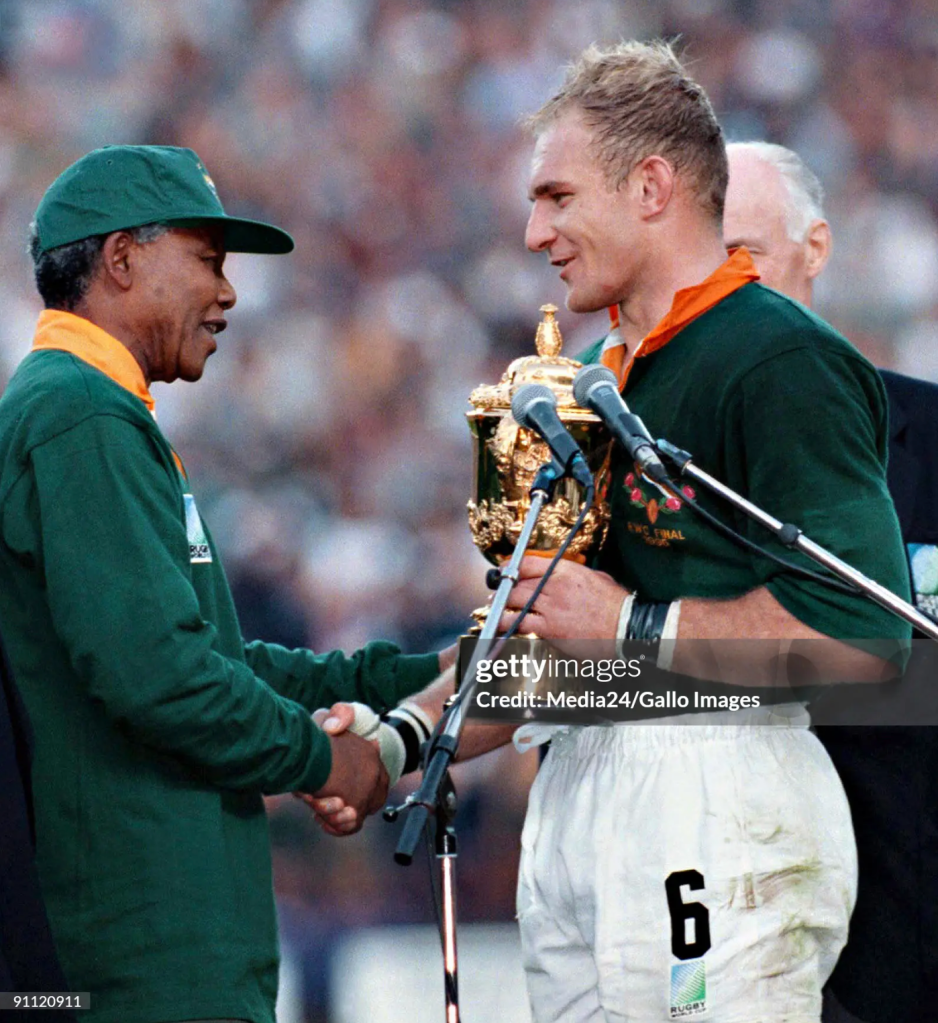
He had a vision, “One Team, One Country”, a view that saw the rugby team represent the whole of South Africa.
To add to his vision, Mandela famously wore the Springbok jersey during the final, which was a symbolic gesture, and it sent a very strong message because a Black president was shown on camera enjoying a historically white sport.
With the help of South Africa winning the tournament, it provided a significant boost to national morale; it helped the nation’s international image, which had previously been damaged for decades, as well as Mandela creating a very powerful narrative for the citizens of South Africa about inclusion, making the country more attractive to its own people.
In 2000, at the Laureus World Sports Awards in Monaco, Mandela famously said, “Sport has the power to change the world. It has the power to inspire. It has the power to unite people in a way that little else does.
It speaks to youth in a language they understand. Sport can create hope where once there was only despair.”
Mandela overcame obstacles, influenced world opinion, and brought about a nation’s resurrection through emotional connections as opposed to political pressure.
Soft Power: Shaping Global Influence in the 21st Century
Fast forward to the 21st century, and there have been many high-profile examples of soft power on show.
From the likes of China and the 2008 Beijing Olympics to Russia and the 2014 Sochi Olympics, these nations tried to manipulate their image worldwide.
When China hosted the 2008 Olympics, it was a significant time to show off their soft power strategy to showcase its national image, economic development, and cultural heritage to a global audience.
The opening ceremony was spectacular and successful, and with the positive result of staging the Games, China was on the hunt for international respect, and the image of “harmony and peace” and “power and innovation” was at the forefront of their plans.
They used four soft power objectives when hosting the Olympics, and these included showcasing progress, cultural diplomacy, cultural dissemination, and international recognition.
The games were used by China to demonstrate the country’s rapidly developing economic growth and technological advancements to showcase their progress worldwide.
By choreographing the opening ceremony as they did, it allowed the Chinese traditional culture to blend in with universal themes, promoting the nation positively.
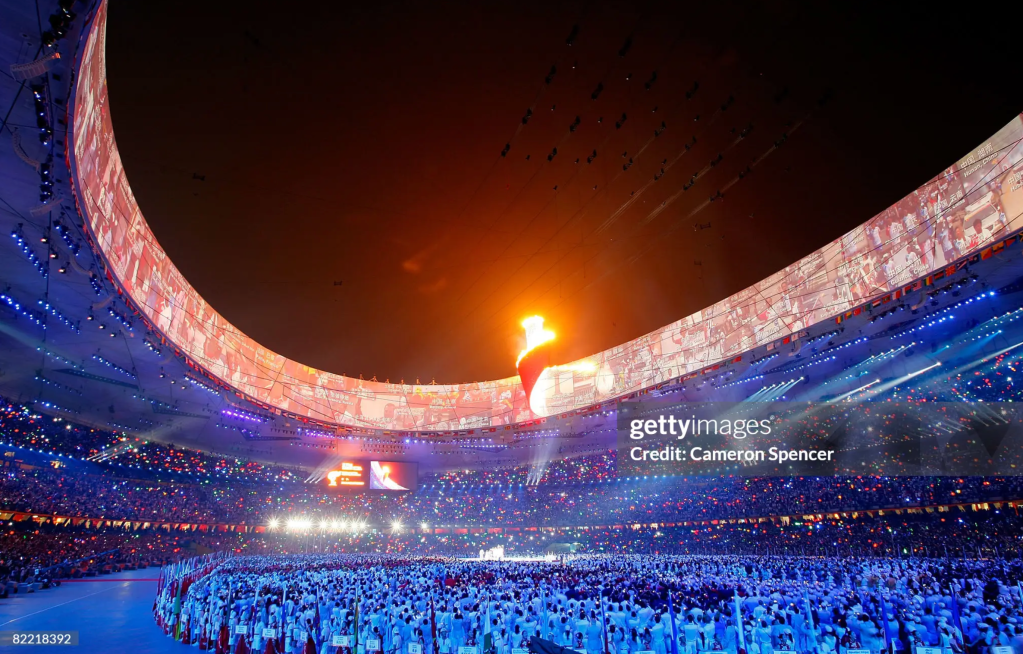
The Olympics served as a platform to promote China’s culture and traditions to a global audience, and it was also seen as a mark of recognition of the country’s international standing, which could keep on growing, as well as cultivating worldwide influence and goodwill.
From East Asia to the Gulf state of Qatar, soft power doesn’t have any boundaries.
The 2022 FIFA World Cup, which was hosted by Qatar, could be viewed as a soft power initiative to enhance the state’s global image by showcasing its capabilities of hosting such a tournament.
Although, the public reacted very negatively to this event being held here, as well as negative publicity of human rights abuses, migrant worker deaths, outdated LGBTQ+ views, and allegations of “sportswashing”.

Qatar aimed for increased tourism and cultural-led supremacy, but the negative aspects of the state led to a positive and negative outcome, presenting both “soft disempowerment” and “soft empowerment”.
Despite the fact that Qatar wanted an entirely positive image after the World Cup, there were mixed outcomes that left the state wondering, why?
The majority of supporters who attended the tournament gave positive overall feedback, and the event did generate outcomes that went in Qatar’s favour in terms of global visibility and potential for future investment and tourism.
Nevertheless, when a mega-event is held in a country with negative views globally, there will always be elements that weren’t so positive for the hosts.
Not only did human rights groups and international media kick up a fuss, but the LGBTQ+ community also had a huge problem with the laws in Qatar, and this led to a significant degree of negative publicity, creating “soft disempowerment”.

In reality, the tournament being held in Qatar was always going to be complex for FIFA to explain, and there were always rumours that corruption was involved with the awarding of the World Cup to the state.
Though, the event demonstrated how contradictory and complex the nature of soft power can be, where chasing positivity from international audiences can inadvertently draw attention to the challenges and weaknesses of a country.
Can soft power go wrong?
Moving from the Middle East to Europe, Russia is also guilty of using soft power to attempt to enhance the country’s image.
They hosted the 2014 Sochi Winter Olympics, which was meant to be a significant moment in their history to showcase themselves internationally with this huge soft power event.
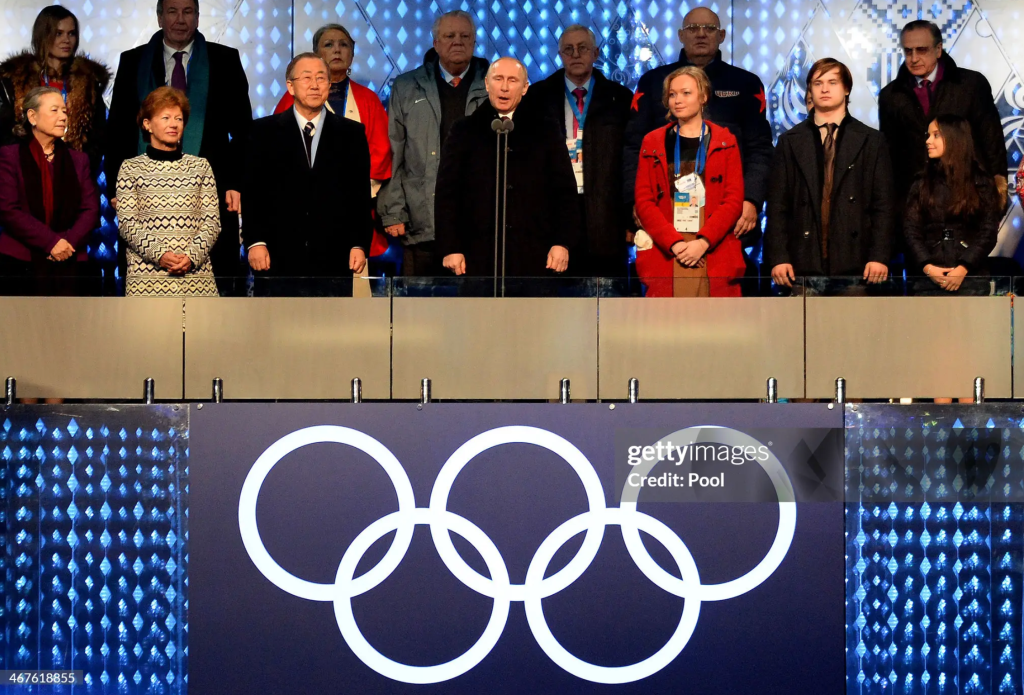
While the Games did receive some domestic attention of power and promoted “Russian-ness” internally, it failed to improve how the world viewed Russia.
International recognition that an event like this should generate never came for the European nation.
Rather than this, the substantial costs and controversy, together with Russia’s previous and more recent hard power actions (which included the invasion of Crimea at the time), caused a major loss of soft power and brought light on the conflict between the nation’s actual hard power-driven foreign policy and its aspirational soft power goals.
What didn’t help Russia was the way in which the Western media framed the event.
They made it look like it was an attempt by Russia to gain recognition through soft power, which furthered the Western view of Russia’s inherent “otherness” and anti-Western position.
There’s no better way to sum up Russia’s attempt at using the event as a soft power strategy:
A National Triumph but International Failure.

The Sochi Olympics ultimately led to a significant loss of the nation’s prestige since its underlying political context and coinciding hard power operations undermined its soft power efforts.
The mechanics of soft power
Instead of using force, soft power is utilised in sport to depict a nation’s values, culture, and positive attributes to foster international influence and goodwill.
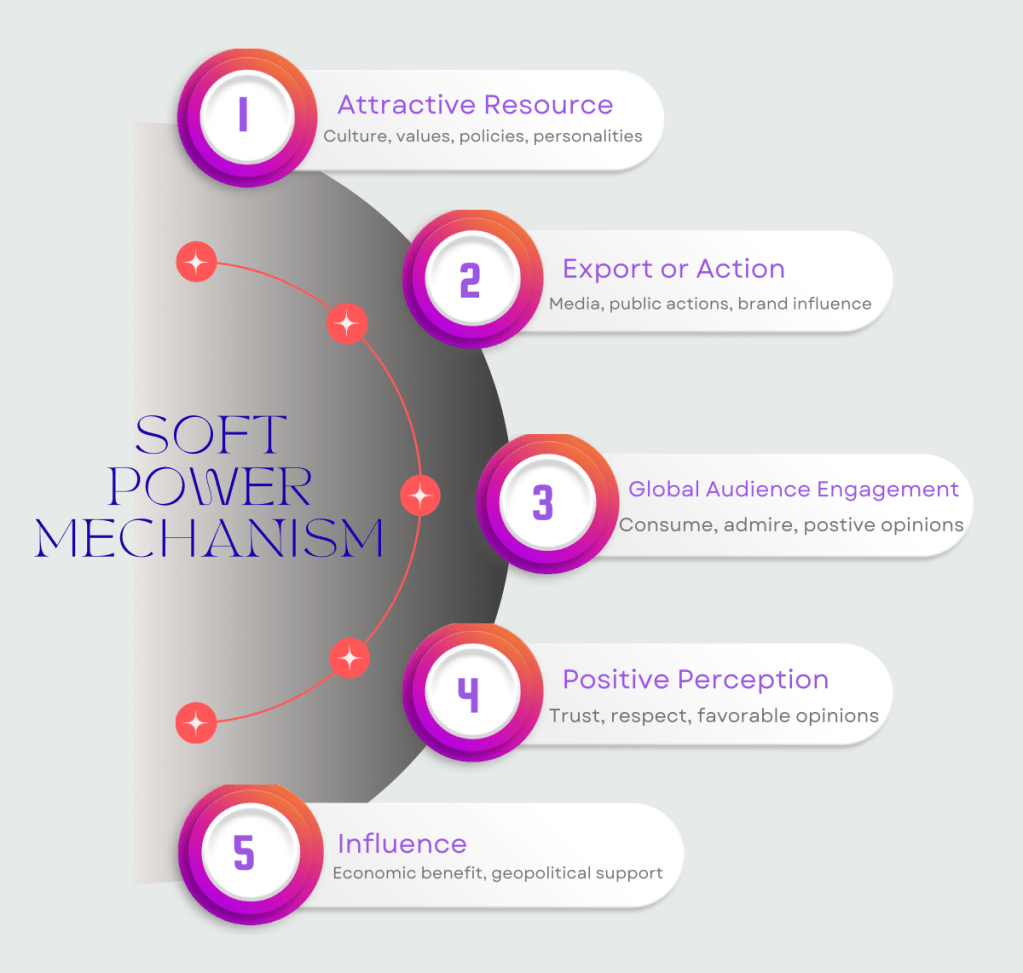
Additionally, the media has a very powerful role to play when it comes to soft power in sport. By broadcasting major events and promoting their positive national and cultural characteristics, these nations can sway perceptions around the world.
Athletes can be portrayed in the media as platforms for cultural diplomacy where people can connect and bond, further reducing tensions between countries and opening new avenues.
A nation’s reputation can be enhanced, and a positive international image is developed, through their athletes when they win major tournaments like the Olympics or World Cup.
LeBron James – Soft power through influence, culture, and advocacy
LeBron James is more than an athlete – he’s a global brand.
Because of his basketball success, popularity, and personality, he has an impact outside of sports.
His fame across the globe reinforces American cultural dominance by assisting in the internationalisation of American culture.
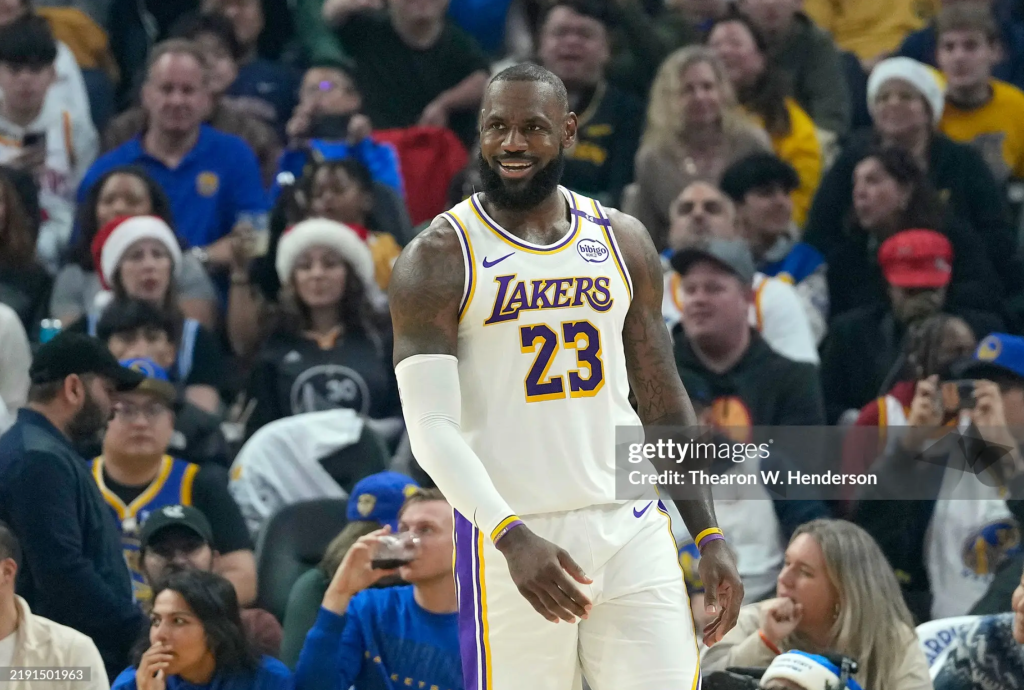
He also uses his reach to talk about current issues like racism, voting rights, and police violence. With these outspoken views, he shapes conversations around the world with the target of helping younger people learn about global problems.
With his worldwide reach, LeBron James founded the “I PROMISE school” in Akron, Ohio, which is a powerful example of social leadership and a prime example of American values like giving.
LeBron James helped and continues to help improve the image of America as a country where successful individuals support their communities.
Megan Rapinoe – Soft power through equality, identity, and global messaging
Megan Rapinoe, another athlete from the US, is an openly gay footballer.
As a vocal homosexual athlete, Rapinoe uses her platform to advocate for LGBTQ+ rights. Her voice reaches a large global population, especially in countries where these debates are relatively new, such as the Middle East.
She positions America on the map as a leader in modern values by challenging accepted norms.
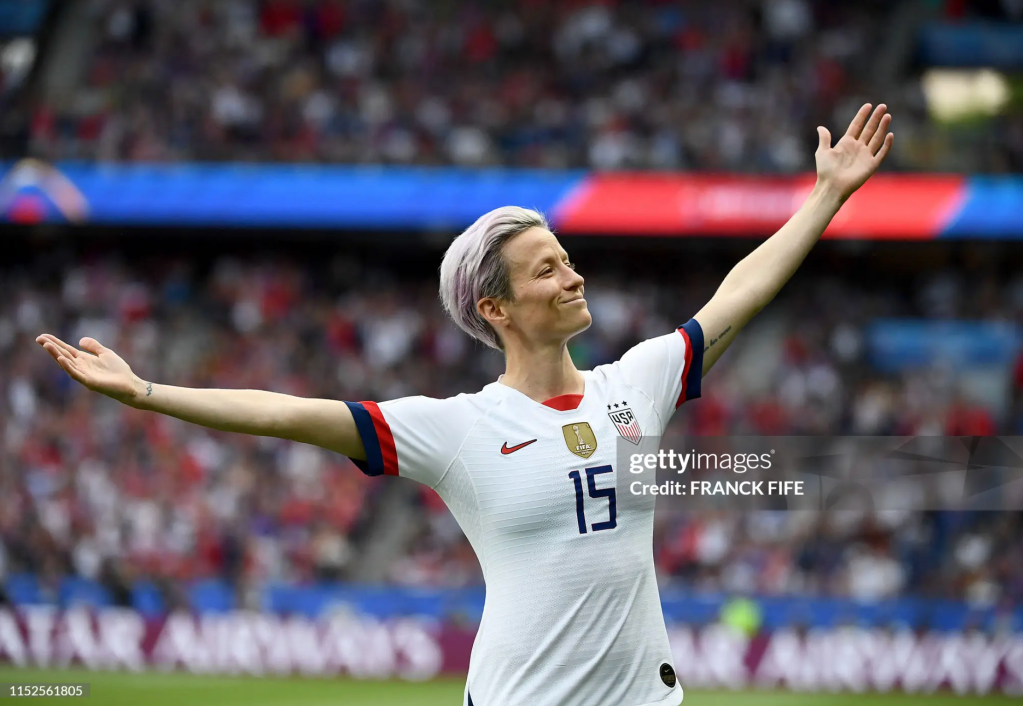
On behalf of the U.S. Women’s National Soccer Team, she has always been very clear with her message around gender equality, including equal pay across the sport.
In an interview with The Guardian in 2019, she stated, “You can’t have it both ways – you can’t stand for equality only when it’s convenient.”
And again, in the same year, she said in a press conference at the FIFA Women’s World cup, “I’m a walking protest when I’m on the field.”
She exemplifies bottom-up soft power, which is not predetermined by governments but rather results from moral and cultural leadership.
Rapinoe won both the female Ballon D’or and Sports Illustrated Sportsperson of the Year awards in 2019, helping herself establish a global presence. She is now seen as a symbol of American courage.
The subtle weaknesses behind influence
With all the positives of soft power that influences the world’s perception of a country, there are weaknesses to nations’ approaches to using this method of enhancing the country’s image globally.
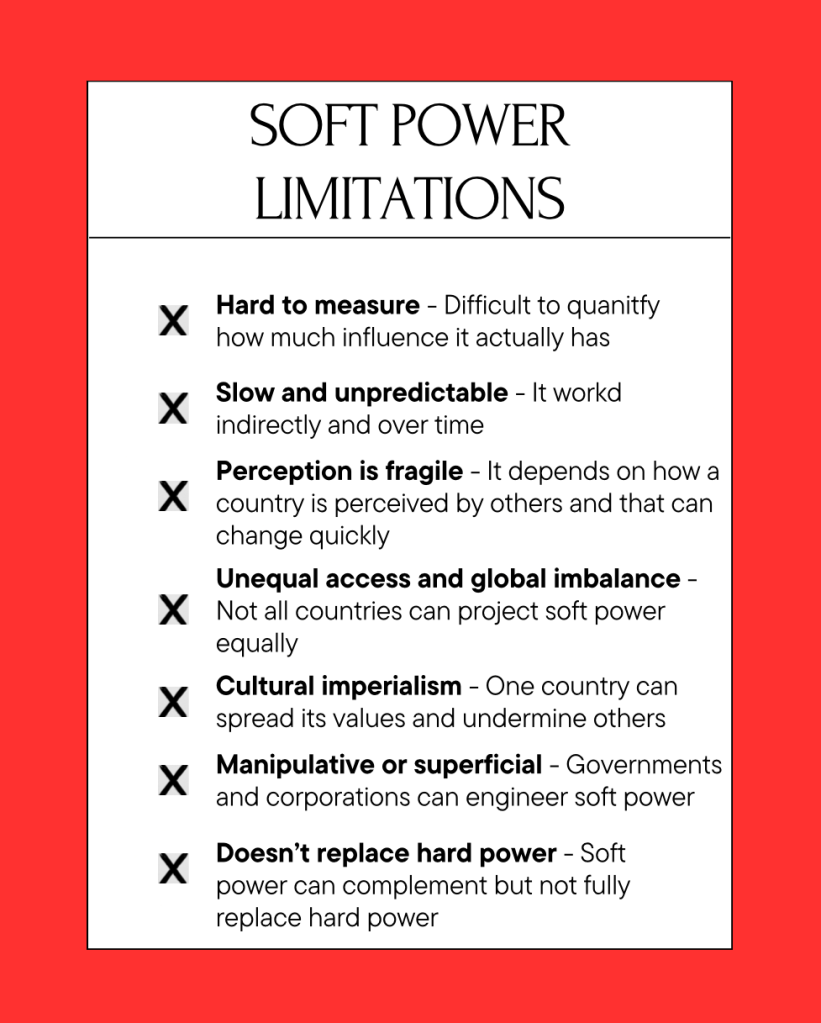
As the image above states, there are several limitations to this specific approach.
Regardless of how hard a country tries to improve its image worldwide, such as Russia and the 2014 Sochi Olympics, it’s mostly about how it’s perceived around the globe.
What nations and corporations must remember is that soft power cannot replace hard power.
Countries like China, Russia and the US are very effective at using hard power when there are global security issues.
While smaller countries, like Sweden, have strong soft power, their hard power and influence globally are very limited.
Soft Power vs Sportswashing
Soft power and sportswashing are two very closely linked ideas that lead to a country or organisation promoting themselves to win over public perception, but they come with their differences.
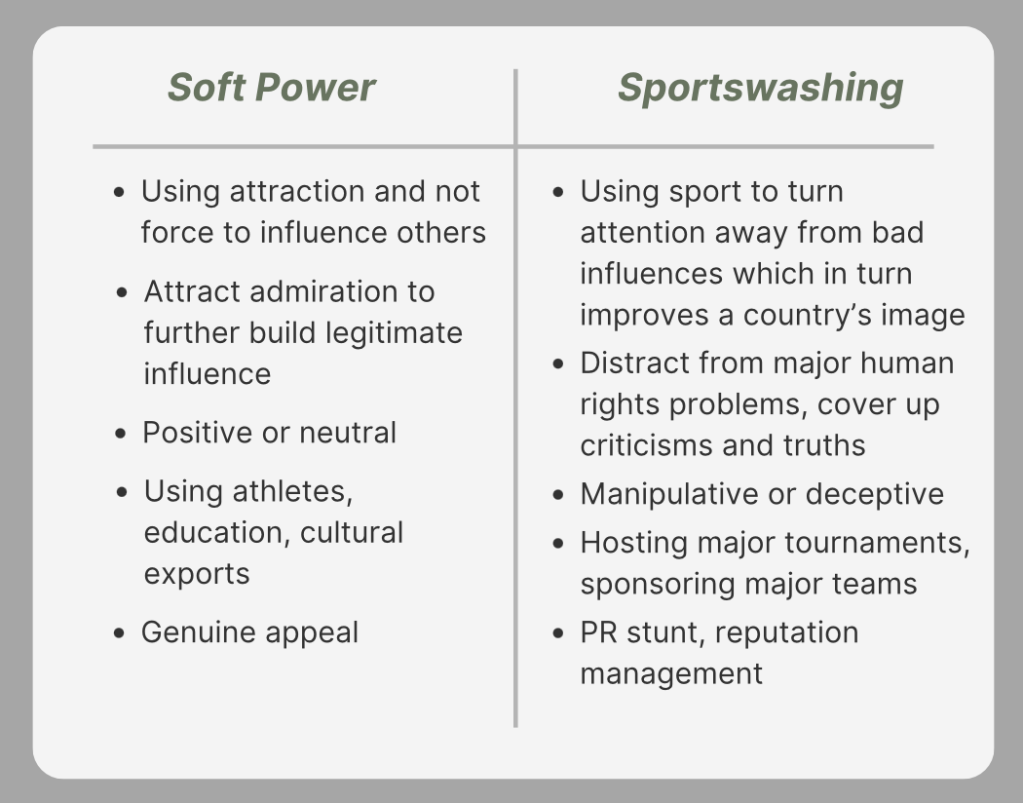
It could be said that Qatar’s bid for the 2022 World Cup was a prime sportswashing example, albeit there were clear soft power strategies employed by the state.
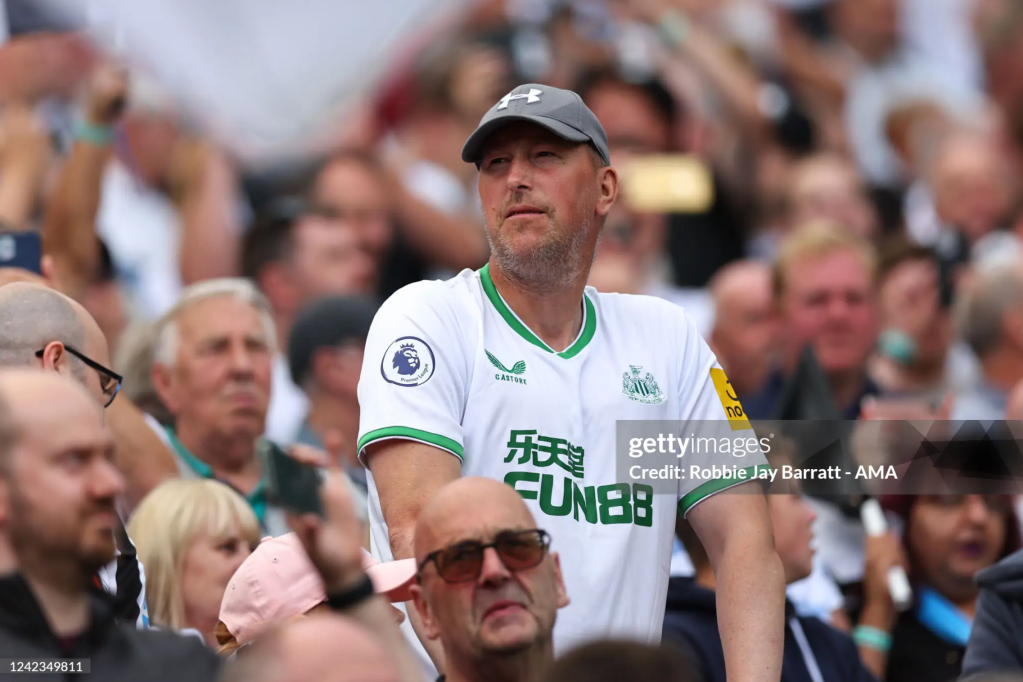
However, one significant sportswashing example that arrived in 2021 is Newcastle United’s takeover by Saudi Arabia.
The PIF of the country bought an 80% stake of the club.
Immediately there was backlash from human rights organisations, especially Amnesty International, and they condemned the takeover, asking the Premier League to hold an emergency meeting
The majority of England were taken aback by this takeover, although Newcastle fans loved it, regardless of the issues around Saudi Arabia and their outdated laws.
They didn’t see it as a symbol of sportswashing but rather the state wanting to dip their feet into the football world.
It didn’t take long for the new owners to make their mark, as less than a year after their takeover, the third kit released by Newcastle for their upcoming season similarly resembled the kit of Saudi Arabia, further showing how sportswashing had entered the Premier League.
Soft Power in Sport: Lessons Still Unlearned?
In soft power, “winning hearts and minds” refers to attracting people and persuading them to support you voluntarily rather than out of obligation or fear by using culture, values, and policies.
“Hearts” refers to winning people’s love, allegiance, and confidence.
“Minds” refers to logically convincing people that your system or ideas make sense or benefit them.
This phrase is closely associated with Sir Gerald Temper (Malaya, 1950s) and was later adapted by the US in Vietnam and Iraq.
Applying this to the modern day, it is true that elite sport in the 21st century has learnt to use soft power dynamics more strategically, going beyond simple hosting to using events for nation branding, diplomacy, and challenging international conventions.

(Photo taken from https://brandfinance.com/insights/global-soft-power-index-2025-the-shifting-balance-of-global-soft-power)
In terms of “winning hearts and minds”, some nations have succeeded in using soft power as an advantageous tool, like China and the Beijing Olympics, as well as the US using both LeBron James and Meghan Rapinoe as influential voices.
However, this learning also entails recognising the heightened awareness and opportunities for reaction that accompany major sporting events, making a thorough and strategic approach to “smart power” increasingly crucial.
 The Sporting Element
Leave a comment